
Seleccionar página
Easily Integrate the Clinical and the Foundational Science
However you teach clinical reasoning, Scope meets your students where they are — whether you're teaching foundational science, guiding a clerkship, or mentoring PGY-1 trainees.
Foundational science
Makes it easy to integrate clinical reasoning training into foundational science instruction, for faculty.
Clerkship
Gives students a rehearsal space to train on diagnoses they have not encountered in the clinic. At the point of care, Scope helps students fill knowledge gaps using trusted sources.
PGY-1 trainees
It’s a rehearsal space for clinical scenarios PGY-1 trainees haven’t yet encountered often enough — building experience before experience is left to chance.
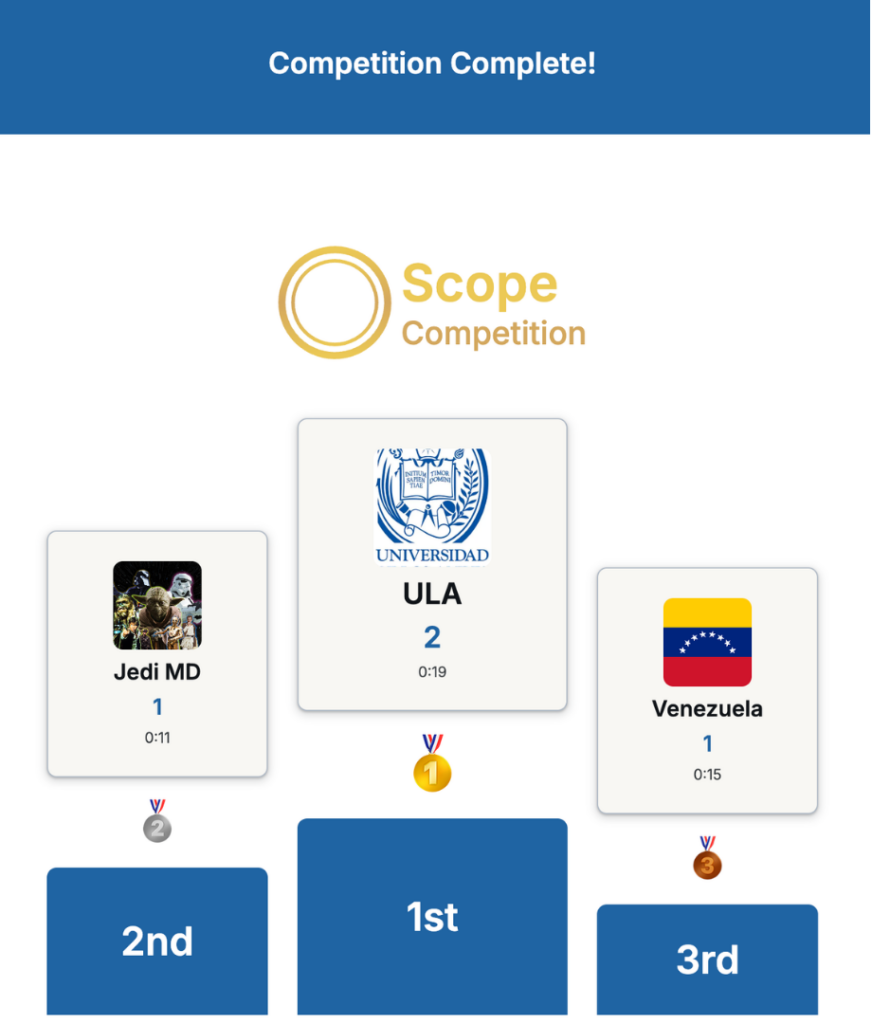
In-class game
Draw students back into the classroom with "Doctor!"
In addition to case studies students complete on their own time, Scope includes Doctor! — an in-class game purpose-built for sophisticated clinical cases. Think Kahoot, but for clinical reasoning. You become the game-show host, while students do the real work: debating, defending, and revising their clinical choices together.
10m
Fast to run
A complete game can take as little as 10 minutes of class time.
2-4
Team-based
Students play in teams of two to four, gathered around a single computer.
Built-in production
Doctor! provides the timer and the music — no setup required.
Bring clinical context
Use Doctor! to connect the day’s foundational science to real clinical reasoning.
inside scope
Built for the hundredth use
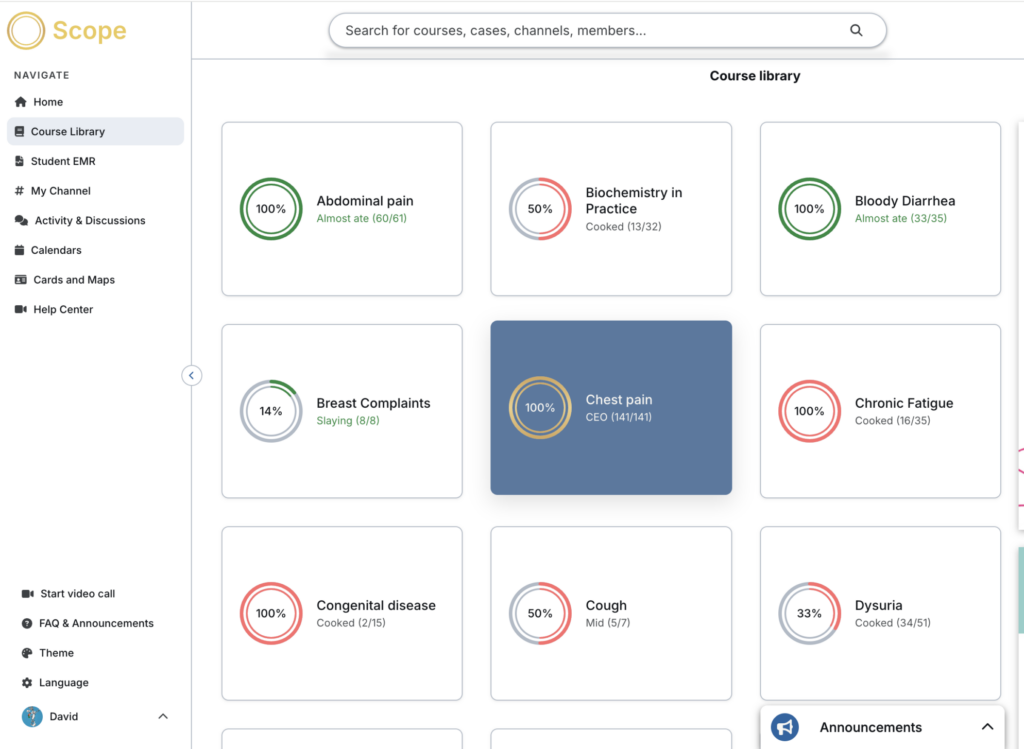
Find case studies with a simple search, author new ones quickly with ScopeAI, and monitor student progress — all in one place.
- •Find cases instantly with a simple search
- •Simple search across your library and the community
- •Student progress tracking, built in
- •Short instructional videos to get you moving fast
Why faculty use Scope
Built by educators, for educators — one platform bridging the classroom and the clinic.

1
Science profs, teach clinical reasoning
Easily assign short clinical cases alongside foundational science reading. Play cases as games in class.
2
Micro-learning
Scope cases are short, so everyone can get back to the explanatory science during and outside class.
3
Publish
Build your own channels on Scope to promote your cases and courses and grow a following–YouTube for case studies.
4
Develop your Clinical Reasoning
Developing your own clinical reasoning skills may be easier than you think: work through Scope case studies yourself. Skeptical? What have you got to lose?
key features
A deliberate practice system for clinical judgment
Modeled on the apprenticeship tradition: learning happens in the flow of work, reasoning develops through solving problems, and knowledge arrives just before — and as — it’s needed.
Publish your own case studies to share with students — and with colleagues around the world.
- ✓Explore a library of cases published by other educators
- ✓Adapt and customize existing cases to fit your course
- ✓Coauthor new cases with ScopeAI in minutes
2
Learning by solving
The struggle and the search are where the learning happens, not the explanation after the fact.
- ✓Search a vast knowledge base before attempting to solve
✓Reason your way to the answer, rather than guessing first
✓Skip the passive learning of a post-hoc explanation
3
Efficient workflow
Built for speed once you know your way around, not for the first five minutes.
- ✓Find cases instantly with a simple search
- ✓Build courses with drag-and-drop speed
- ✓Monitor student progress, all within Scope
4
Community collaboration
Build together with colleagues at your institution or around the world.
- ✓Coauthor cases and courses as a team
- ✓Create and grow your own channels
- ✓Collaborate with built-in video and messaging
How to Get Started
Quick Sign Up
Register for a free account on app.scope.education and set up your educator profile.
Try a Few Case Studies
Go to the 'Course Library' and work through the first case or two in a few courses. Use the help section if stuck.
Add Cases to your Channel
Pick one of the cases and add it to your channel, then create a course and drag the case into the course.
Performance is earned through practice.
The distance between learning and knowing is doing.