
Reimagining the Tradition of Medical Apprenticeship
The scientific revolution and the age of enlightenment altered medical education in wonderful ways, but perhaps something was lost.
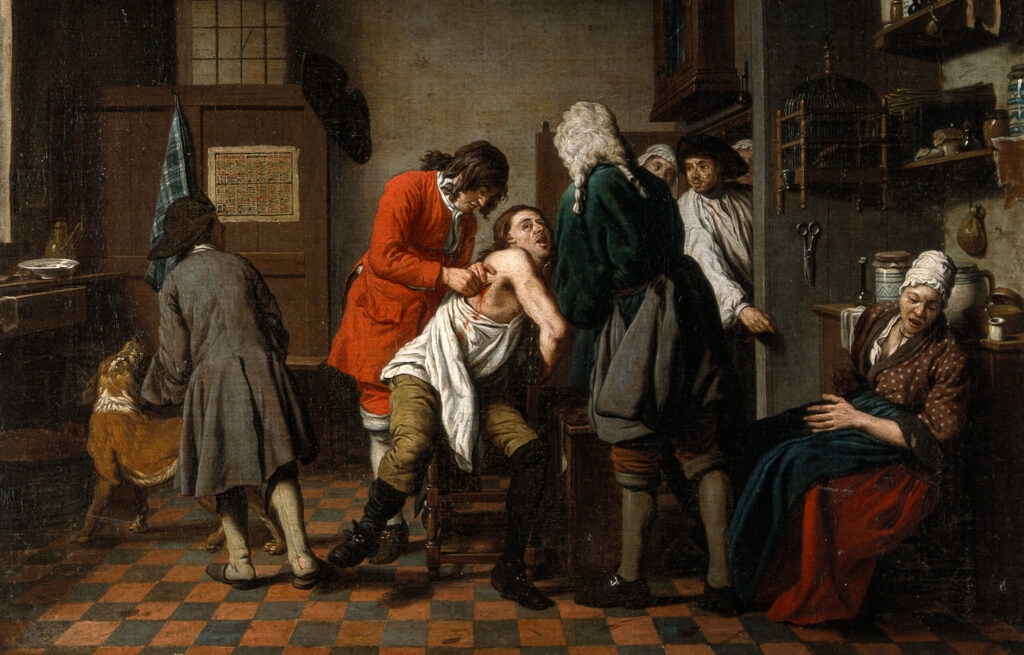
Until the late 18th century, surgeons and apothecaries trained as an apprentice to a master for 7 years. Upwards of 14,000 patient encounters would have been completed by the apprentice in those 7 years–14,000 patients diagnosed and treated by the apprentice under direct supervision.
Also, through teaching, the master continued their own learning.
Only now has technology allowed us to return to this effective and efficient way of learning through doing, while simultaneously incorporating all the past and present scientific discoveries that inform contemporary practice.
Scope provides a practice environment that speeds the learning of both the clinical and the foundational science like nothing previously possible.
Further, educators continue their learning through the authoring and publishing of case studies in Scope.
Students also achieve the top of Bloom’s taxonomy of learning (creation) through authoring and publishing their own cases.
There has never been a better time to learn medicine.
Apprenticeship, rebuilt for modern medical education
Scope gives MD, DO, PA, and NP students a place to practice clinical reasoning before—and alongside—caring for real patients. Through complete, case-based patient encounters in a student EMR, learners take histories, build and refine differential diagnoses, choose investigations, interpret findings, and make management decisions. When they reach the edge of their knowledge, supporting foundational science and clinical resources are available in the flow of the case. The educational platform, including Scope’s case library and knowledge resources, is free for students and educators.
The Science Behind Scope
Evidence-based cognitive principles engineered for rapid learning and long-term retention.
Spaced Repetition
Solve every case in a course, and revisit difficult cases many times to convert complex diagnostic judgement and the foundational science into permanent clinical intuition with minimal memorization. Dive deeper into the science each time through. The apprentice, the athlete, and the musician train through repetition, rest, and repetition. Scientists call it 'spaced repetition', but it's nothing new, we just stopped doing it in the 18th century when we switched from apprenticeships to books and lectures.
Smart Feedback Loops
Proficiency dashboards automatically track your progress, steering your study time toward areas that need focus. Repeating what you already have mastered feels like progress; avoid this trap. Train your weaknesses.
5-Minute Micro-Cases
Our minds can only learn 2-3 new concepts per patient encounter. Long case studies waste time directly, by taking too long to complete, but also because too much learning is attempted in one case. The more we try to learn at once, the less we actually remember. Today, scientists call this 'micro-learning'. Scope's cases are meant to take 5 minutes, until you reach a high level, when cases may take 15 minutes.
Learn in the Flow of Work (LIFOW)
Learn One
Before seeing real patients, master care workflows, clinical judgement, and foundational science by playing and rehearsing through 5-minute gamified case studies.
Do One
Use Scope in clerkships during real patient encounters. Scope’s knowledge cards and workflows will answer your questions with just a click. (students only! Scope’s student edition is not to be used as an EMR or clinical decision support by licensed clinicians)
Teach One
Creating (Bloom’s taxonomy) and teaching (Feynman technique) are the final steps in learning. Turn your clinic experiences into shareable cases on your channel to cement your mastery and to contribute to the development of your classmates and those who follow you.
Learn, Practice, and Lead in One Place
Case Library
There are already hundreds of peer-reviewed Scope case studies authored by our team of physicians and curated in our course library. Importantly, there are also hundreds more cases and courses published on Scope by professors, clinicians, and your student peers that they share on their own channels (YouTube style). Subscribe to their channel, and add their cases to your channel (Spotify style). You may even adapt their cases to suit your purposes. Of course, publish your own creations to your own channel as well.
Achieve More in Less Time
Knowledge recall is context dependent. By actively solving patient problems in case vignettes and full case studies, you are practicing in the proper context for clerkships, Step exams, shelf exams and residency. Acquiring and employing knowledge in the proper context is practice, not studying. Studying is passive and done out of context. By centering learning around the solving of a patient’s problems, both the clinical and the foundational science is learned far faster, and remembered in context; when and where it is needed.
Quickly fill Knowledge Gaps with our Living Encyclopedia
Our living encyclopedia fills knowledge gaps as you practice, just like a mentor would, but smarter and quicker. Everything you need is accessed with one click on the concept you do not understand. Scope’s knowledge cards explain both the clinical and the underlying science with video, images, authoritative quotes, reference links, and AI.
These knowledge cards were curated for you by physicians. Knowledge cards must be seen to be understood; some of our community claim this to be Scope’s greatest help.
Build Your Own Channel
For clinical Rotations and Placements
Use Scope’s Student EMR (SEMR) to organize encounter details, compose your clinical notes, and help you orally present the patient during clinical rotations. Importantly, Scope’s living encyclopedia (knowledge cards) is available in the Scope SEMR, to fill your knowledge gaps quickly in clinic.
Group play in class and online
We’ve built group play capability into Scope that allows professors in class, or groups of friends online to run case studies as team competitions, live. Scope’s integrated video conferencing features are used to play the cases online. Be sure to watch our instructional videos on how to run these games. Reach out to us in Scope’s internal message system if you would like a personal tutorial (David Loney). Any case study can be played as a game. Your first time leading a game may be tricky, but it really is quite simple. It’s also very fun and rewarding.
“If you want to travel fast, go alone, if you want to travel far, travel with others” (African proverb).